Form 4 Physics imtixaanka qaranka 2024 iyo jawaabihiisa
Imtixaanka qaranka Fasalka 4aad ee 2024 ee Form 4 Physics, su'aal su'aal. Ku gal adigoo waqti leh sida imtixaanka dhabta ah, kadibna arag jawaabta iyo sharaxa su'aal kasta.
- 56 su'aalood, 100 dhibcood
- 120 daqiiqo
Gal imtixaankan
120 daqiiqo, 100 dhibcood. Su'aalaha doorashada waa laguu saxayaa; jawaabaha qoraalka adiga ayaa ku saxaya qodobada sixitaanka.
Akoon bilaash ah ayaa loo baahan yahay si aad u bilowdo, si jawaabahaaga iyo natiijooyinkaaga loo kaydiyo.
Tilmaamaha ardayga
Answer all questions in the ANSWER BOOKLET.
PART ONE: CHOOSE THE CORRECT ANSWER [40 MARKS]
- 12 dhibcood
For Hooke's Law "Force is proportional to [i.e.: F α ........]"
- A.Displacement(x)
- B.velocity(v)
- C.Energy(E)
- D.Power(P)
- 22 dhibcood
Which one of the following frequencies is an infrasonic vibration?
- A.Below 20Hz
- B.20Hz - 20KHz
- C.Above 20KHz
- D.10MHz
- 32 dhibcood
The below four springs are stretched as noted in the diagram which mass oscillates with highest frequency. (Each spring carries a 100 g mass; extensions: A 15 cm, B 20 cm, C 25 cm, D 30 cm.)
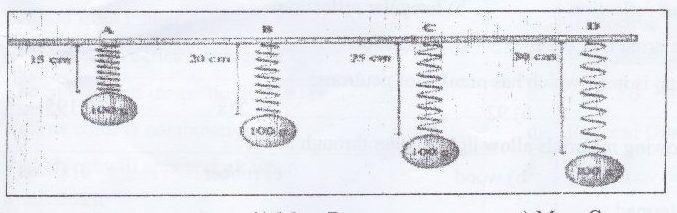
- A.Mass A
- B.Mass B
- C.Mass C
- D.Mass D
- 42 dhibcood
An object is placed at the focal length of a concave mirror. If the focal length of the mirror is 15 cm. the distance of the image will be
- A.7.5 cm
- B.15 cm
- C.zero
- D.infinity
- 52 dhibcood
The SI - unit of induced Electromotive force is
- A.T.m^2
- B.Joule
- C.Weber
- D.Volt
- 62 dhibcood
The type of electricity produced by a battery is
- A.AC
- B.DC
- C.Direct Voltage
- D.emf
- 72 dhibcood
When we want to construct electric circuits, we use symbols to represent the elements of the circuit. Which of the following represent the symbol of capacitor? (a: zigzag line; b: two parallel plates; c: coil; d: triangle with a bar, labelled anode and cathode)

- A.a
- B.b
- C.c
- D.d
- 82 dhibcood
A ray of Monochromatic light passing through air, is incident on water. Which one of the following will be the same for reflected and refracted ray?
- A.Speed
- B.wavelength
- C.direction
- D.Frequency
- 92 dhibcood
Which one of the following is NOT correct about the total internal reflection
- A.Brilliant of the Dimond
- B.working of optical fiber
- C.mirage formation
- D.real and apparent depth of pond.
- 102 dhibcood
All the following are properties of Gamma rays EXCEPT
- A.They have high energy among electromagnetic waves
- B.They carry no charge
- C.They are not affected by magnetic and electric fields
- D.They have very high ionization power
- 112 dhibcood
The diagram below represents (parallel incident rays strike a rough surface and are reflected in different directions)
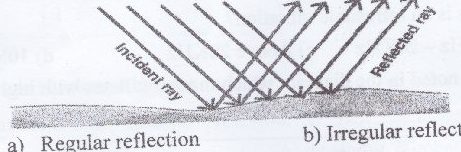
- A.Regular reflection
- B.Irregular reflection
- C.Total internal reflection
- D.diffraction
- 122 dhibcood
Uranium 238/92 U is an isotope which has number of neutrons:
- A.146
- B.92
- C.238
- D.195
- 132 dhibcood
Which of the fallowing materials allow light to pass through them:
- A.Iron
- B.wood
- C.rubber
- D.Glass
- 142 dhibcood
A push or pull is termed as:
- A.Force
- B.acceleration
- C.Speed
- D.velocity
- 152 dhibcood
The degree of hotness or coldness is known as:
- A.Heat
- B.Temperature
- C.Electricity
- D.Density
- 162 dhibcood
The process of changing substances from solid to liquid is
- A.Melting
- B.Freezing
- C.Boiling
- D.Condensation
- 172 dhibcood
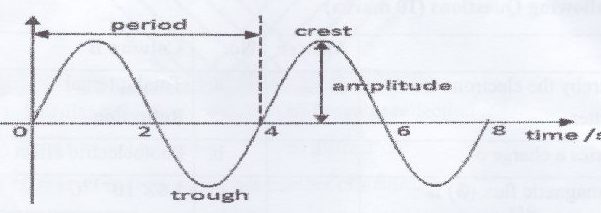
The number of waves in the diagram below are:
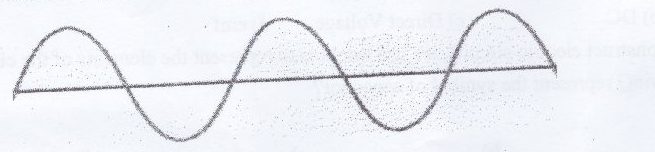
- A.2
- B.2.5
- C.5
- D.3.5
- 182 dhibcood
The best transmitter medium of sound is
- A.Solid
- B.Liquid
- C.Gas
- D.Plasma
- 192 dhibcood
A convex lens of focal length (f) is in contact with a concave lens of the same focal length. What will be equivalent to the focal length of the combination?
- A.F
- B.2F
- C.zero
- D.infinity
- 202 dhibcood
Which one of the following figures show a uniform motion? (distance-time graphs: a horizontal line; b straight sloping line through the origin; c curve getting steeper; d rise then fall)
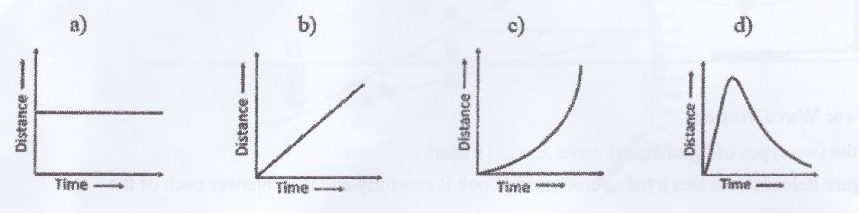
- A.a
- B.b
- C.c
- D.d
Part Two: Match the Following Questions (10 marks)
- M11 dhibcood
Match the following. The process whereby the electrons are emitted from matter Column B: a. Total internal Reflection; b. Photoelectric effect; c. 1.6×10^-19 C; d. Red and Green; e. Weber; f. blue light; g. 20 N; h. Thermometer; i. Dispersion; j. Can see distinct objects.
- M21 dhibcood
Match the following. Each electron caries a charge of Column B: a. Total internal Reflection; b. Photoelectric effect; c. 1.6×10^-19 C; d. Red and Green; e. Weber; f. blue light; g. 20 N; h. Thermometer; i. Dispersion; j. Can see distinct objects.
- M31 dhibcood
Match the following. The SI - unit of magnetic flux (Ø) is Column B: a. Total internal Reflection; b. Photoelectric effect; c. 1.6×10^-19 C; d. Red and Green; e. Weber; f. blue light; g. 20 N; h. Thermometer; i. Dispersion; j. Can see distinct objects.
- M41 dhibcood
Match the following. Yellow color is combination of Column B: a. Total internal Reflection; b. Photoelectric effect; c. 1.6×10^-19 C; d. Red and Green; e. Weber; f. blue light; g. 20 N; h. Thermometer; i. Dispersion; j. Can see distinct objects.
- M51 dhibcood
Match the following. Red object will appear dark when irradiated to Column B: a. Total internal Reflection; b. Photoelectric effect; c. 1.6×10^-19 C; d. Red and Green; e. Weber; f. blue light; g. 20 N; h. Thermometer; i. Dispersion; j. Can see distinct objects.
- M61 dhibcood
Match the following. Mirage is a phenomenon formed by Column B: a. Total internal Reflection; b. Photoelectric effect; c. 1.6×10^-19 C; d. Red and Green; e. Weber; f. blue light; g. 20 N; h. Thermometer; i. Dispersion; j. Can see distinct objects.
- M71 dhibcood
Match the following. An instrument used for measuring temperature is Column B: a. Total internal Reflection; b. Photoelectric effect; c. 1.6×10^-19 C; d. Red and Green; e. Weber; f. blue light; g. 20 N; h. Thermometer; i. Dispersion; j. Can see distinct objects.
- M81 dhibcood
Match the following. Short - sighted person Column B: a. Total internal Reflection; b. Photoelectric effect; c. 1.6×10^-19 C; d. Red and Green; e. Weber; f. blue light; g. 20 N; h. Thermometer; i. Dispersion; j. Can see distinct objects.
- M91 dhibcood
Match the following. A fish of mass 2kg has a weight of Column B: a. Total internal Reflection; b. Photoelectric effect; c. 1.6×10^-19 C; d. Red and Green; e. Weber; f. blue light; g. 20 N; h. Thermometer; i. Dispersion; j. Can see distinct objects.
- M101 dhibcood
Match the following. When white light splits into its component colors Column B: a. Total internal Reflection; b. Photoelectric effect; c. 1.6×10^-19 C; d. Red and Green; e. Weber; f. blue light; g. 20 N; h. Thermometer; i. Dispersion; j. Can see distinct objects.
Part three: Direct questions and problems [50 Marks]
- S1.12 dhibcood
Section One: Oscillatory Motion. What does the period of simple harmonic motion depend on? [2 marks]
- S1.23 dhibcood
Section One: Oscillatory Motion. The diagram below shows a pendulum. What is the length of this pendulum if it has a period of 2.5 sec. (use g = 9.8 m/s^2) [3 marks]
- S2.11 dhibcood
Section Two: Wave Motion. Name the two types of Mechanical wave (1 Mark)
- S2.2a1 dhibcood
Section Two: Wave Motion. The figure below illustrates a transverse wave (displacement against time/s; one period marked from 0 to 4 s). Calculate its period [1 mark]
- S2.2b2 dhibcood
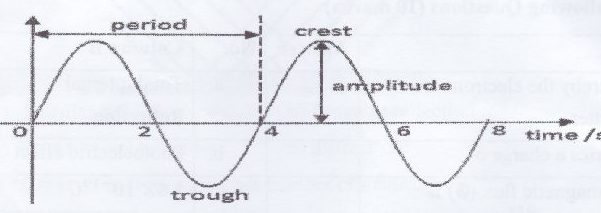
Section Two: Wave Motion. The figure below illustrates a transverse wave (period 4 s from the graph). Find its frequency [2 marks]
- S2.2c2 dhibcood
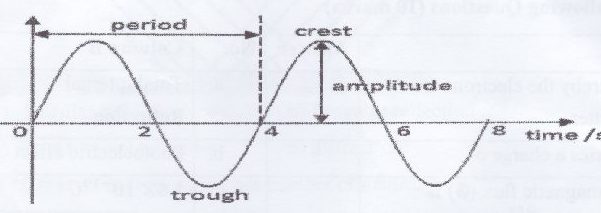
Section Two: Wave Motion. The figure below illustrates a transverse wave (period 4 s on a time axis). What is the speed of the wave? [2 marks]
- S3.11 dhibcood
Section Three: Sound waves. Define Echo [1 mark]
- S3.25 dhibcood
Section Three: Sound waves. An ambulance car moving with a speed of 40 m/s is emitting a sound of frequency 500Hz find the frequency heard by a person standing at the side of the road when the ambulance is moving away from the person (take v = 345 m/s). (5 mark)
- S4a1 dhibcood
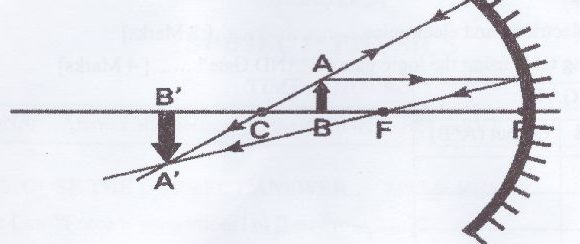
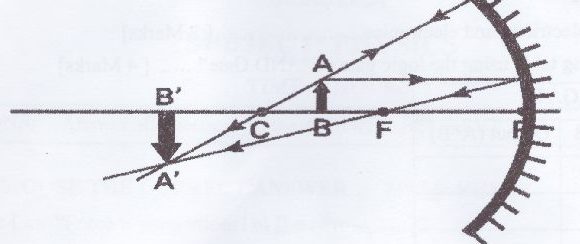
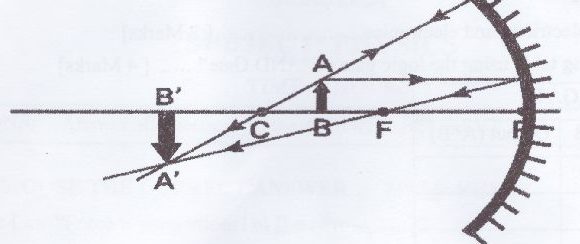
Section Four: Reflection of light. The figure below illustrates an object placed between a center (C) and a focal point (F) of a concave Mirror. Complete the characteristic of the image: The position of the image [1 mark]
- S4b1 dhibcood
Section Four: Reflection of light. Object between C and F of a concave mirror. Complete the characteristic of the image: The nature of the image [1 mark]
- S4c1 dhibcood
Section Four: Reflection of light. Object between C and F of a concave mirror. Complete the characteristic of the image: The size of the image [1 mark]
- S5.12 dhibcood
Section Five: Refraction of light. Find the critical angle of a glass block whose refractive index is 1.5 [2 marks]
- S5.2a1 dhibcood
Section Five: Refraction of light. Two thin lenses of focal lengths +50 cm and -70 cm are placed in Contact with each other calculate: The focal length of the combination [1 mark]
- S5.2b2 dhibcood
Section Five: Refraction of light. Two thin lenses of focal lengths +50 cm and -70 cm are placed in contact (combined focal length 175 cm). The power of the combination [2 marks]
- S5.2c1 dhibcood
Section Five: Refraction of light. Two thin lenses of focal lengths +50 cm and -70 cm are placed in contact. The nature of the combination [1 mark]
- S6.13 dhibcood
Section Six: Dispersion of light. Why does the sun appear reddish during sunset or sunrise? [3 Marks]
- S6.2a1 dhibcood
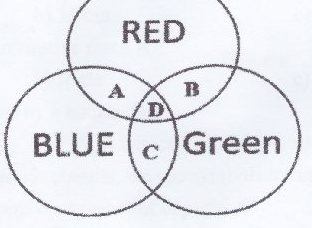
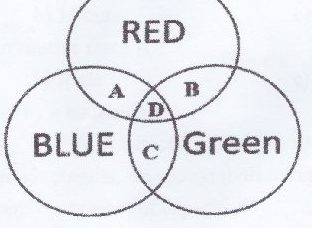
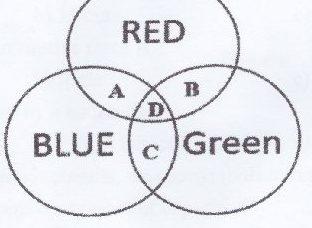
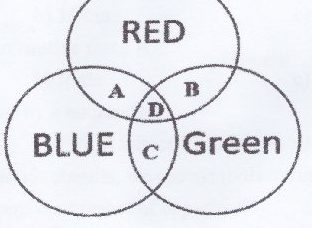
Section Six: Dispersion of light. The diagram represents three overlapping circles of additive colors (Red, Blue, Green). What color would region A (red and blue overlap) be?
- S6.2b1 dhibcood
Section Six: Dispersion of light. Three overlapping circles of additive colors (Red, Blue, Green). What color would region B (red and green overlap) be?
- S6.2c1 dhibcood
Section Six: Dispersion of light. Three overlapping circles of additive colors (Red, Blue, Green). What color would region C (blue and green overlap) be?
- S6.2d1 dhibcood
Section Six: Dispersion of light. Three overlapping circles of additive colors (Red, Blue, Green). What color would region D (all three overlap) be?
- S8a3 dhibcood
Section Eight: Alternating Current. A 10 H inductor is connected to a voltage of 220V with frequency 50Hz. Calculate: The reactance of the inductor [3 Marks]
- S8b2 dhibcood
Section Eight: Alternating Current. A 10 H inductor is connected to a voltage of 220V with frequency 50Hz (reactance 3142 Ω). Current in the circuit [2 Marks]
- S9.12 dhibcood
Section Nine: Electronics. Distinguish between electricity and electronics [2 Marks]
- S9.24 dhibcood
Section Nine: Electronics. Complete the following table using the logic gate of "AND Gate" [4 Marks]: Inputs A, B: 0 0; 0 1; 1 0; 1 1. Output (A*B) = ?
- S11.12 dhibcood
Section Eleven: Nuclear Physics. Given that the chlorine isotope 35/17 Cl, find: a) its mass number b) its Neutron number c) its atomic number d) its number of protons [2 marks]
- S11.24 dhibcood
Section Eleven: Nuclear Physics. A copper coin has a certain mass. Calculate the nuclear energy (in MeV) that is required to separate completely all neutrons from protons. Use the actual mass of 63/29 Cu, given as 62.91367 amu [4 marks]
Imtixaanka waxaa diyaarisay Federal Ministry of Education, Culture and Higher Education (MoECHE), Somalia. Waxaa lagu wadaagay bilaash si ardaydu ugu diyaargaroobaan. Jawaabaha iyo sharaxyada waxaa qoray macallimiinta Sheerxirfad.
Imtixaanada kale ee hore ee Form 4 Physics
- Imtixaanka qaranka 2024/202559 su'aalood, 100 dhibcood, 120 daqiiqo
- Imtixaanka qaranka 202250 su'aalood, 100 dhibcood, 120 daqiiqo
- Imtixaanka qaranka 202148 su'aalood, 100 dhibcood, 120 daqiiqo
- Imtixaanka qaranka 202039 su'aalood, 100 dhibcood, 120 daqiiqo
- Imtixaanka qaranka 201851 su'aalood, 100 dhibcood, 120 daqiiqo