Form 4 Physics national exam 2018 with answers
The 2018 Form 4 national exam paper for Form 4 Physics, question by question. Take it timed like the real exam, then see the answer and explanation to every question.
- 51 questions, 100 marks
- 120 minutes
Take this paper
120 minutes, 100 marks. Multiple choice is marked for you; you mark your written answers against the marking points.
A free account is needed to start, so your answers and results are saved.
Instructions to candidates
This paper consists of 12 printed pages. There are 2 sections: Part One: 20 Multiple Choice Questions (40 marks), Part Two: 7 Structured Questions (60 marks). Answer all questions in the spaces provided. No extra paper is allowed.
PART ONE: Multiple Choice (40 marks)
Answer all questions. Circle the correct answer.
- 12 marks
Which of the following electromagnetic waves has the highest frequency?
- A.X-ray
- B.Gamma ray
- C.Ultraviolet
- D.Infrared waves
- 22 marks
Beta particles are actually
- A.Protons
- B.Electrons
- C.Neutrons
- D.Neutral
- 32 marks
Which of the following is an application of radioactivity?
- A.Fission
- B.Fussion
- C.Half-life
- D.Carbon dating
- 42 marks
The image formed by a convex mirror is always
- A.Real
- B.Virtual
- C.Same size
- D.Magnified
- 52 marks
The region of total darkness formed behind an opaque body is called:
- A.penumbra
- B.Convergent beam
- C.Umbra
- D.Divergent beam
- 62 marks
A substance that does not allow light energy to pass through it is called
- A.Transparent
- B.Opaque
- C.Luminous
- D.Translucent
- 72 marks
Rainbow is formed due to:
- A.Interference of light
- B.Absorption of light
- C.Dispersion of light
- D.Diffraction of light
- 82 marks
A ray of light R strikes normal to a plane mirror as shown in the figure. Which of the rays A, B, C or D represents the correct reflected ray?
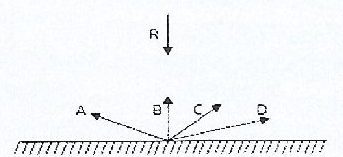
- A.A
- B.B
- C.C
- D.D
- 92 marks
An object O is placed in front of a plane mirror as shown. Which of the points A, B, C or D will the observer see the image of the object in the plane mirror
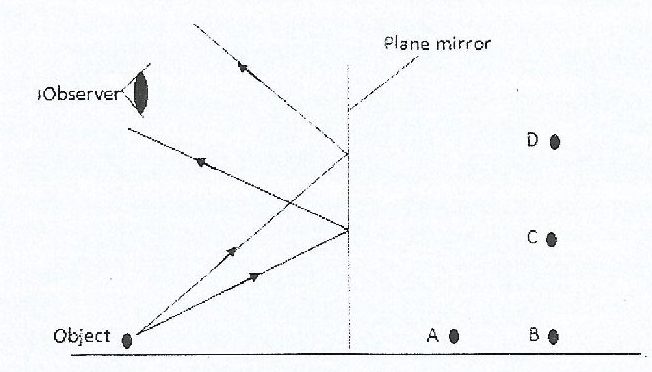
- A.A
- B.B
- C.C
- D.D
- 102 marks
A student shakes the end of a rope with a frequency of 1.5 Hz, causing waves with a wavelength of 0.8 m to travel along the rope. What is the velocity of the waves?
- A.1.9 m/s
- B.1.6 m/s
- C.1.2 m/s
- D.5.3 m/s
- 112 marks
The following diagram shows a wave. [The 12 m marked on the diagram runs from the first crest to the third crest; 0.2 m is marked from crest to trough.] Which row in the table gives the wavelength and amplitude of the wave?
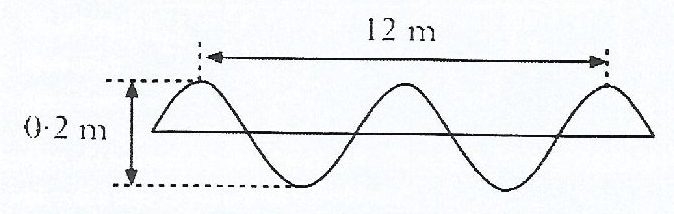
- A.Wavelength 4 m, Amplitude 0.2 m
- B.Wavelength 6 m, Amplitude 0.1 m
- C.Wavelength 6 m, Amplitude 0.2 m
- D.Wavelength 12 m, Amplitude 0.1 m
- 122 marks
The diagram below represents a wave. [Displacement between 0.20 m and -0.20 m; three complete waves span 6.0 m.] What is the speed of the wave if its frequency is 8.0 hertz?
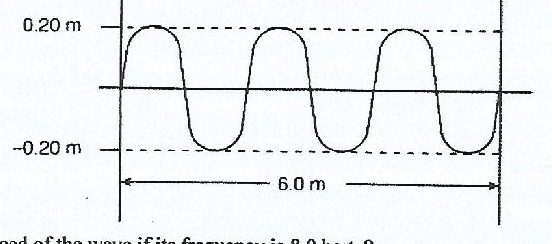
- A.48 m/s
- B.3.2 m/s
- C.16 m/s
- D.1.6 m/s
- 132 marks
The diagram shows how displacement varies with time as a wave passes a fixed point. What is the frequency of this wave?
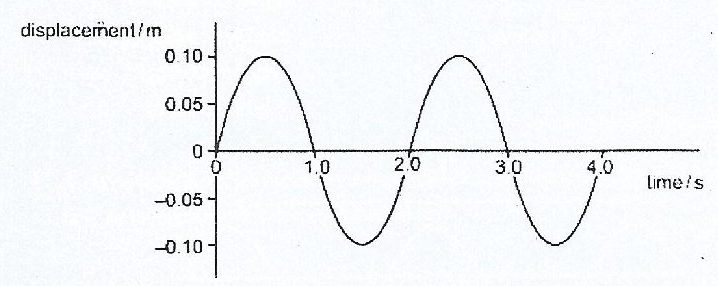
- A.0.25Hz
- B.0.50Hz
- C.1.0Hz
- D.2.0Hz
- 142 marks
The loudness of a sound is determined mainly by its
- A.amplitude.
- B.speed.
- C.frequency.
- D.pitch.
- 152 marks
What is the wavelength of a 264-Hz sound wave when the speed of sound is 345 ?
- A.0.77 m
- B.1.31 m
- C.6.09 m
- D.9.11 m
- 162 marks
Waves that are produced on a guitar string by plucking it are
- A.sound waves
- B.acoustic waves
- C.transverse waves
- D.longitudinal waves
- 172 marks
What is the kinetic energy of an object with a mass of 10 kilograms traveling at a speed of 10 meters per second?
- A.100 J
- B.500 J
- C.1000 J
- D.5,000 J
- 182 marks
Which of the following radiations is used for sterilizing food
- A.Alpha ray
- B.X-ray
- C.Gama ray
- D.Beta ray
- 192 marks
Which of the following is NOT radioactive detector
- A.Geiger Muller Tube
- B.Cloud Chamber
- C.Joule meter
- D.Spark counter
- 202 marks
The half-life of a radioactive material is 24 years. The activity of a sample falls to a fraction of its initial value after 72 years. What is the fraction?
- A.1/3
- B.1/4
- C.1/6
- D.1/8
PART 2: (60 marks) Answer all questions
- B1a1 mark
Question 1 - Oscillatory Motion. Fill in the blank spaces with a suitable word. a) The ratio of the external force acting on a spring to the extension is called _____
- B1b1 mark
Question 1 - Oscillatory Motion. Fill in the blank spaces with a suitable word. b) The motion of a body about their mean position is known as _____
- B1c3 marks
Question 1 - Oscillatory Motion. c) The length of a spring is 8cm. When a mass of 4kg is hung to it, its length becomes 16cm. The spring constant is?
- B2i1 mark
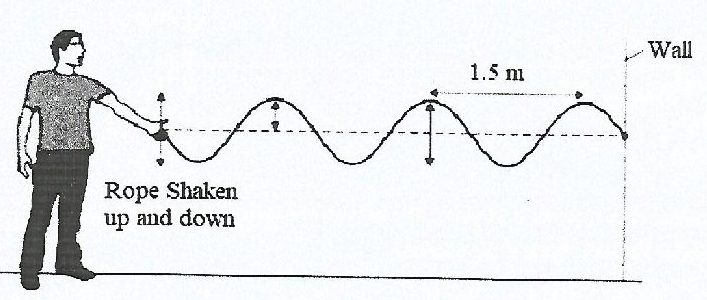
Question 2: Waves. Mohamed shakes a rope up and down to produce a wave as shown below. The waves are not reflected by the wall. (i) Draw an arrow on the diagram to show the direction in which the waves transfer energy.
- B2ii1 mark
Question 2: Waves. Mohamed shakes a rope up and down to produce a wave as shown below. The waves are not reflected by the wall. (ii) The waves produced on the rope are transverse. Name one other type of transverse wave.
- B2iii1 mark
Question 2: Waves. Mohamed shakes a rope up and down to produce a wave as shown below. The waves are not reflected by the wall. (iii) The rope is shaken up and down, producing 3 waves every second. The waves have a wavelength of 1.5 metres. State the frequency of the waves.
- B2iv3 marks
Question 2: Waves. Mohamed shakes a rope up and down to produce a wave as shown below. The waves are not reflected by the wall. (iv) Calculate the speed of the waves. (The rope produces 3 waves every second with a wavelength of 1.5 metres.)
- B3.12 marks
Question 3: Sound. 1. Name any two sources of sound waves
- B3.2a2 marks
Question 3: Sound. 2. a) A musical instrument produces a sound wave with a frequency of 1000 Hz. The sound wave has a wavelength of 0.34 m in air. Calculate the speed of the sound wave in air. (v = λf)
- B3.2b2 marks
Question 3: Sound. b) In water the speed of sound is different. The speed of a sound wave in water is 1300 m/s. The sound wave has a frequency of 1000Hz. Calculate the wavelength of this sound wave.
- B3.2c4 marks
Question 3: Sound. c) The diagram shows a ship using an Echo locator (SONAR) to find a shoal of fish near Mogadishu in the Indian Ocean. The pulsed wave is transmitted from the ship, which is then reflected off the top of the shoal and is then picked up by the receiver. The time taken to receive the echo is 3s after transmission and the speed of sound in water is 1500m/s. Calculate how deep the ship has to lower its fishing nets to catch the top of the shoal.
- B3.2d1 mark
Question 3: Sound. (d) Define the term 'ultrasound wave'
- B3.2e1 mark
Question 3: Sound. (e) Give one other use of ultrasound waves (apart from echo location)
- B4.11 mark
Question 4: Properties of light. 1. Define the term light.
- B4.23 marks
Question 4: Properties of light. 2. What are the three important characteristics of light?
- B4.3a3 marks
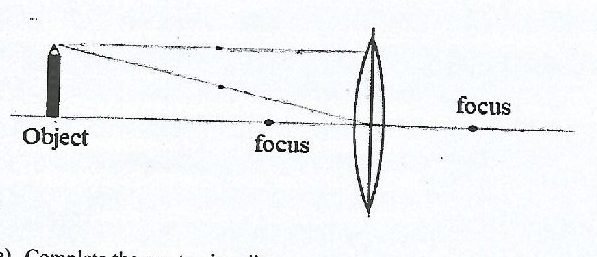
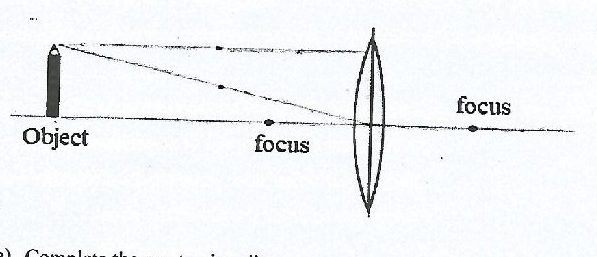
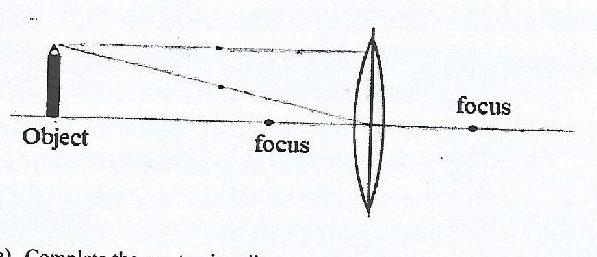
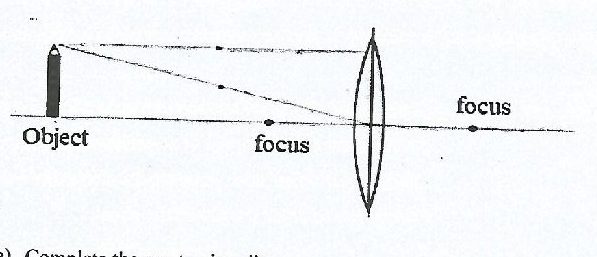
Question 4: Properties of light. 3. The diagram below shows a partly drawn ray-tracing diagram (an object placed in front of a converging lens, beyond twice the focal length, with one ray parallel to the axis and one ray through the focus). (a) Complete the ray-tracing diagram.
- B4.3bi1 mark
Question 4: Properties of light. 3. The diagram below shows a partly drawn ray-tracing diagram (an object placed in front of a converging lens, beyond twice the focal length, with one ray parallel to the axis and one ray through the focus). (b) Is the image produced (i) real or virtual?
- B4.3bii1 mark
Question 4: Properties of light. 3. The diagram below shows a partly drawn ray-tracing diagram (an object placed in front of a converging lens, beyond twice the focal length, with one ray parallel to the axis and one ray through the focus). (b) Is the image produced (ii) upright or inverted?
- B4.3biii1 mark
Question 4: Properties of light. 3. The diagram below shows a partly drawn ray-tracing diagram (an object placed in front of a converging lens, beyond twice the focal length, with one ray parallel to the axis and one ray through the focus). (b) Is the image produced (iii) enlarged or diminished?
- B5.12 marks
Question 5: Dispersion of Light. 1. White light is a mixture of seven colours. Name them.
- B5.22 marks
Question 5: Dispersion of Light. 2. Define the term dispersion of light.
- B5.3a2 marks
Question 5: Dispersion of Light. 3. a) What is a spectrum?
- B5.3b2 marks
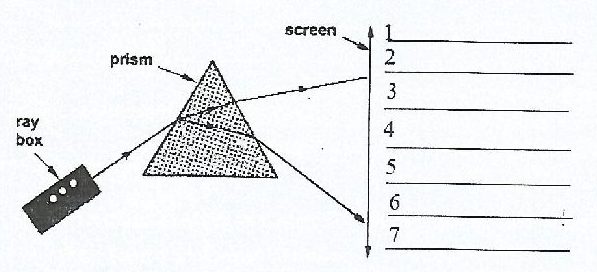
Question 5: Dispersion of Light. b) Below is a diagram of a prism. For each line, indicate the colour that appears on the white screen from number 1 to 7 in the diagram.
- B5.3c2 marks
Question 5: Dispersion of Light. c) What is meant by the refraction of light?
- B5.3d2 marks
Question 5: Dispersion of Light. d). Which colour of the spectrum has i) Maximum refraction ii) Minimum refraction
- B6.12 marks
Question 6: Reflection of Light. 1. State the laws of reflection.
- B6.22 marks
Question 6: Reflection of Light. 2. If a person stands 4m from a plane mirror, what is the distance between the person and his image?
- B6.32 marks
Question 6: Reflection of Light. 3. State two uses of convex mirrors.
- B7.14 marks
Question 7: Refraction of Light. 1. State Snell's law of refraction.
- B7.23 marks
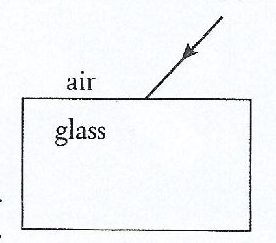
Question 7: Refraction of Light. 2. The diagram below shows a light ray travelling through air to the interface between the air and a glass block. On the diagram draw the normal, and a possible path for the ray in the glass.
- B7.32 marks
Question 7: Refraction of Light. 3. Explain why the sky appears blue during the day.
Paper set by the Federal Ministry of Education, Culture and Higher Education (MoECHE), Somalia. Shared free of charge to help students prepare. The answers and explanations are written by Sheerxirfad teachers.