Form 4 Physics national exam 2020 with answers
The 2020 Form 4 national exam paper for Form 4 Physics, question by question. Take it timed like the real exam, then see the answer and explanation to every question.
- 39 questions, 100 marks
- 120 minutes
Take this paper
120 minutes, 100 marks. Multiple choice is marked for you; you mark your written answers against the marking points.
A free account is needed to start, so your answers and results are saved.
Instructions to candidates
Write all answers on the answer booklet. Write legibly in dark blue pen only. Answer all questions as provided in the question paper.
Part A: Multiple-Choice Question (40 Marks)
Choose the correct answer and write it in the answer booklet.
- 12 marks
A motion of an object that regularly returns to a given position after a fixed time interval is
- A.Periodic motion
- B.Harmonic motion
- C.Oscillatory motion
- D.Wave motion
- 22 marks
The maximum potential energy of vibrating mass attached to a spring is at an equilibrium when at a:
- A.Lower position
- B.Rest position
- C.Extreme position
- 32 marks
Waves transfer:
- A.Molecules
- B.Atoms
- C.Energy
- D.Matter
- 42 marks
Ahmed measures the room temperature during a sunny day using the thermometer below. The reading of the thermometer is

- A.30°C
- B.20 °C
- C.28°C
- D.25°C
- 52 marks
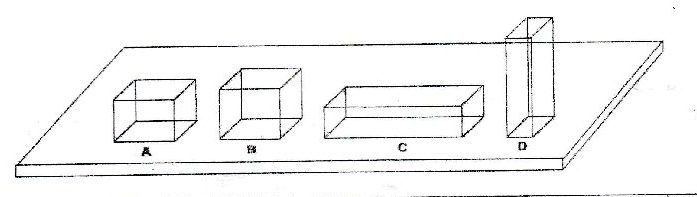
All of the four objects A, B, C and D have the same weight. Which one produces the greatest pressure on the table?
- A.D
- B.A
- C.C
- D.B
- 62 marks
Radio Mogadishu broadcasts on a frequency of 90MHz with a speed of 3x10^8m/s. The wavelength will be:
- A.3,33m
- B.3.33m
- C.2.22m
- D.4.44
- E.10.10m
- 72 marks
In hospitals, doctors use machines that utilize a sound wave for imaging unborn babies (fetuses). This type of sound wave is:
- A.Infrasonic
- B.Sonic
- C.Ultrasonic
- D.Audible sonic
- 82 marks
A person sees his/her image in a plane mirror because the mirror
- A.Absorbs light
- B.Reflects light
- C.Transmits light
- D.Diffuses light
- 92 marks
When a newspaper is seen through a lens, its print appears larger. The nature of the lens is:
- A.Convex
- B.Converging
- C.Parabolic
- D.Concave
- 102 marks
Identify the primary colours of light?
- A.Red, blue, cyan
- B.Red, green, violet
- C.Yellow, green, blue
- D.Red, green, blue
- 112 marks
Light is a form of energy produced by a _____
- A.Luminous object
- B.Transparent object
- C.Non-luminous object
- D.Translucent object
- 122 marks
When we shine a yellow light on a red card, the reflected color will be:
- A.Blue
- B.Red
- C.Green
- D.Cyan
- 132 marks
An object is placed at a distance of 20cm from a concave mirror whose focal length is 10cm. The distance of image is
- A.30cm
- B.60cm
- C.150 cm
- D.20 cm
- 142 marks
What is the focal length of the combination of two thin lenses of power +5D and -2D placed in contact with each other?
- A.-3m
- B.33.33m
- C.-0.33m
- D.3m
- 152 marks
The process of causing small nuclei to stick together into a larger nucleus is known as
- A.Fusion
- B.Fission
- C.Radioactivity
- D.Mass defect
- 162 marks
Which of the following about the Gamma ray is true?
- A.It carries a positive charge
- B.It carries a negative charge
- C.It is an electromagnetic waves
- D.It is similar to electrons
- 172 marks
The image produced by a concave lens is:
- A.Always virtual and enlarged
- B.Always virtual and smaller
- C.Always real
- D.Sometimes real and sometimes virtual
- 182 marks
An object placed at 2m from a plane mirror is shifted by 0.5m away from the mirror. What is the distance between the object and its image?
- A.2m
- B.1.5m
- C.5m
- D.3m
- 192 marks
Which of the following describes a change of frequency?
- A.Echoes
- B.Loudness
- C.Beats
- D.Pitch
- 202 marks
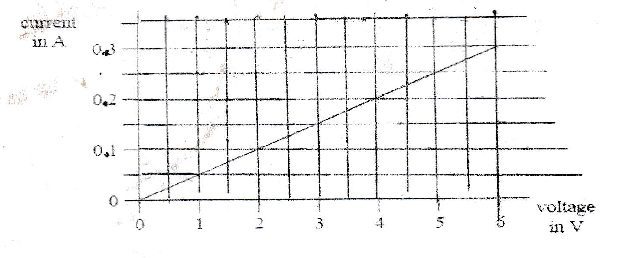
A student investigates how the current in a resistor varies with voltage. The student plots a graph of his/her result. When the potential difference is 4v, the current is:
- A.0.2A
- B.0.3A
- C.0.1A
- D.0.4A
PART B: Structured Questions (60 marks)
Answer all the questions and write your answers in the answer booklet.
- 21bi1 mark
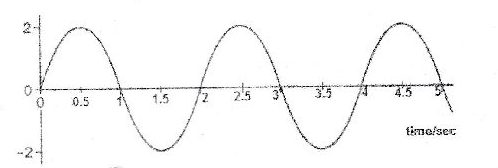
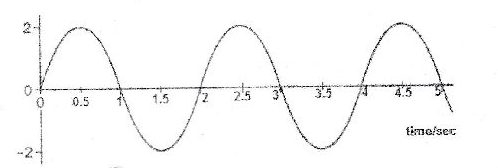
21. Waves. The diagram shows a transverse wave (displacement from -2 to 2 against time in seconds). Find the amplitude of the wave
- 21bii1 mark
21. Waves. The diagram shows a transverse wave (displacement from -2 to 2 against time in seconds). Find the frequency of the wave
- 21c2 marks
Differentiate between transverse and longitudinal waves
- 21d2 marks
Fatima shakes a rope which forms a wave whose wavelength is 10cm and its frequency is 20Hz. What is the speed of the wave?
- 21ei1 mark
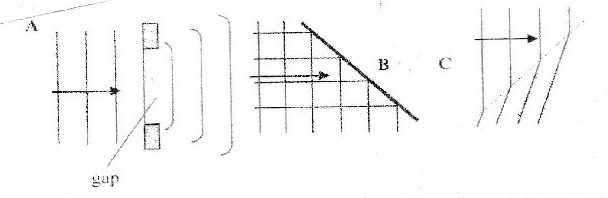
Diagrams A, B and C show the behavior of waves (A: waves passing through a gap, B: waves meeting a slanted barrier, C: waves bending as they cross a boundary). Use the table (Refraction, reflection, Diffraction, Polarization, interference) to complete: A is _____
- 21eii1 mark
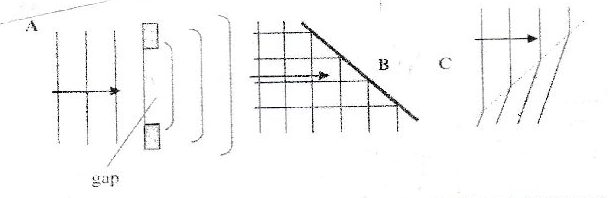
Diagrams A, B and C show the behavior of waves (A: waves passing through a gap, B: waves meeting a slanted barrier, C: waves bending as they cross a boundary). Use the table (Refraction, reflection, Diffraction, Polarization, interference) to complete: B is _____
- 21eiii1 mark
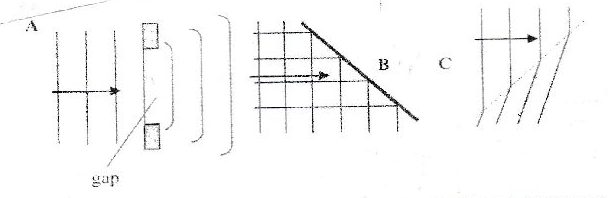
Diagrams A, B and C show the behavior of waves (A: waves passing through a gap, B: waves meeting a slanted barrier, C: waves bending as they cross a boundary). Use the table (Refraction, reflection, Diffraction, Polarization, interference) to complete: C is _____
- 21f2 marks
What is the difference between a node and an antinode?
- 22a2 marks
22. Refraction of light: What is Snell's law of refraction?
- 22bi2 marks
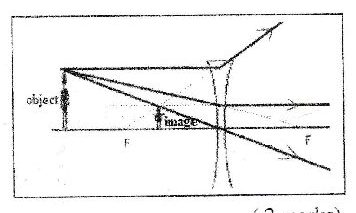
The diagram shows an object and its image formed by a lens. What type of lens is shown in the diagram?
- 22bii2 marks
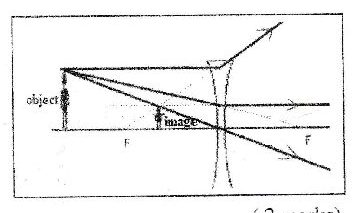
The diagram shows an object and its image formed by a lens. Is the image real or virtual?
- 22c2 marks
An object is placed 15cm from a convex lens of a focal length of 10cm. Find the position of the image.
- 22d2 marks
A ray of light strikes the surface of a material at an angle of 45° such that the angle of refraction is 30°. Calculate the refractive index of the material.
- 23a2 marks
23. Nuclear physics: Define the term "isotopes"
- 23bi1 mark
Find the missing value of the following reaction: (238 over 92)U -> (X over Y)Th + (4 over 2)He + Energy
- 23bii1 mark
Find the missing value of the following reaction: (14 over 6)C -> (X over Y)N + (0 over -1)e + Energy
- 23ci2 marks
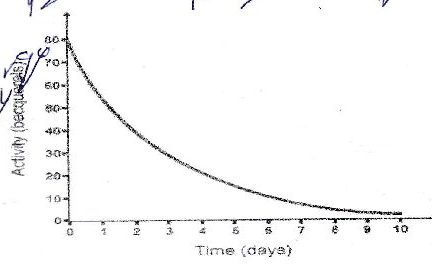
The graph shows how the activity of radioactive sample varies with time (activity in becquerels, from 80 at time 0, against time in days). From the graph above, what would the activity of the sample become after 6 days?
- 23cii2 marks
Explain the meaning of "half-life"
- 23d1 mark
Use the words in the box (Gamma rays, Beta particles, Alpha particles) to fill the blank: Which has the most penetrating power?
Paper set by the Federal Ministry of Education, Culture and Higher Education (MoECHE), Somalia. Shared free of charge to help students prepare. The answers and explanations are written by Sheerxirfad teachers.