Form 4 Biology national exam 2018 with answers
The 2018 Form 4 national exam paper for Form 4 Biology, question by question. Take it timed like the real exam, then see the answer and explanation to every question.
- 40 questions, 100 marks
- 120 minutes
Take this paper
120 minutes, 100 marks. Multiple choice is marked for you; you mark your written answers against the marking points.
A free account is needed to start, so your answers and results are saved.
Instructions to candidates
This paper consists of 12 printed pages. There are 2 sections: Section 1: 20 Multiple Choice Questions (40 Marks), Section 2: 13 Structured Questions (60 Marks). Answer all questions in the spaces provided. No extra paper is allowed.
PART 1: 20 MULTIPLE CHOICE QUESTIONS
Circle the correct answer. (40 marks)
- 12 marks
The junction between dendrites of two adjacent neurons is:
- A.Myeline
- B.Synapse
- C.Neurolemma
- D.Synovial
- 22 marks
Which of the following hormones control basal metabolic activity?
- A.Prolactin
- B.Adrenaline
- C.Oxytocin
- D.Thyroxine
- 32 marks
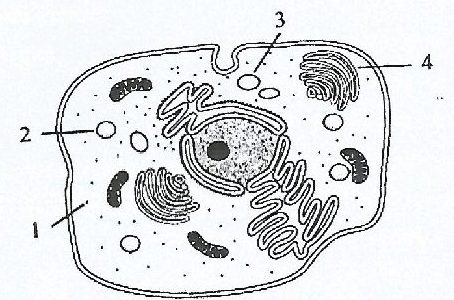
The diagram below shows a cell with four of its parts numbered. Which numbered part is a ribosome?
- A.1
- B.2
- C.3
- D.4
- 42 marks
Which term describes the maintenance of a steady internal state in the body?
- A.gametogenesis
- B.mitosis
- C.homeostasis
- D.respiration
- 52 marks
The inheritance of a trait in humans is best described as being determined by
- A.a single allele
- B.one or more pairs of alleles
- C.one pair of chromosomes
- D.the sex chromosomes of the offspring.
- 62 marks
During fruit formation the wall of the ovary becomes...............
- A.Plumule
- B.Petals
- C.Pistil
- D.Pericarp
- 72 marks
A signal that the bladder is full is sent to the central nervous system by
- A.feedback loops
- B.sensory neurons
- C.nephron tubules
- D.receptor proteins.
- 82 marks
Which of the following trophic levels of a food chain is correct?
- A.Lion -> Fox -> Grass -> Goat
- B.Grass -> Goat -> Fox -> Lion
- C.Fox -> Grass -> Lion -> Goat
- D.Goat -> Grass -> Lion -> Fox
- 92 marks
The grafian follicles bursts open to release a mature ovum. This condition is called
- A.Menstruation
- B.Fertilization
- C.Implantation
- D.Ovulation
- 102 marks
The following are DNA components except?
- A.Five carbon molecules
- B.ATP molecule
- C.Phosphate molecule
- D.Nitrogenous base molecule
- 112 marks
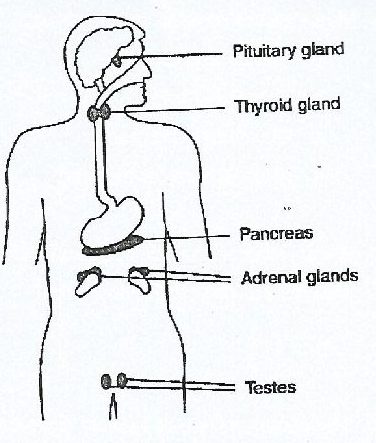
The labeled organs in the diagram are part of which human body system? [Labelled: pituitary gland, thyroid gland, pancreas, adrenal glands, testes.]
- A.respiratory
- B.digestive
- C.circulatory
- D.endocrine
- 122 marks
Which of the following is a female gamete?
- A.Ovum
- B.Ovules
- C.Ovary
- D.Oviduct
- 132 marks
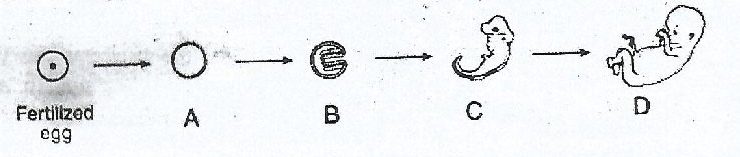
The diagram shows four stages in the development of a human after fertilization. Between stages A and D, which process must occur?
- A.mutation
- B.sexual reproduction
- C.cell division
- D.extinction
- 142 marks
Motor nerves transfer impulse from:
- A.Glands to muscles
- B.Muscles to brain
- C.Glands to spinal cord
- D.Brain to muscles or gland
- 152 marks
A tall father with allele (TT) and a tall mother with allele (Tt). The probability of shortness of their children will be?
- A.1/2
- B.1/8
- C.1/4
- D.2/3
- 162 marks
The common form of asexual reproduction of bacteria is:
- A.Binary fission
- B.Sporulation
- C.Budding
- D.Multiple fission
- 172 marks
The diagram below shows the structure of neuron. The letter A represents?
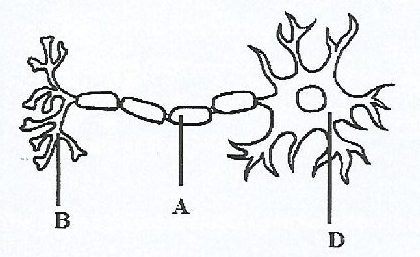
- A.Cell body
- B.Axon
- C.Dendrum
- D.Cyton
- 182 marks
Which type of genes do NOT segregate during meiosis?
- A.Linkage genes
- B.Dominant genes
- C.Recessive genes
- D.Mutant genes
- 192 marks
The diagram shows human arm. What happens to muscle X and Y when the arm is straightened?
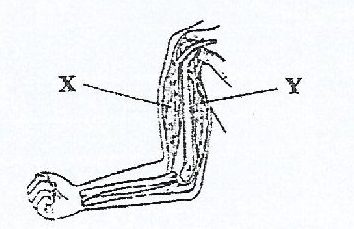
- A.X: Contract, Y: Contract
- B.X: Contract, Y: Relaxes
- C.X: Relaxes, Y: Contracts
- D.X: Relaxes, Y: Relaxes
- 202 marks
The study of interrelationship of organisms to each other and their environment is;
- A.Habitat
- B.Biosphere
- C.Genetics
- D.Ecology
PART TWO: STRUCTURED QUESTIONS (60 Marks)
- B1a3 marks
1. Define the following terms: a) Genetics
- B1b3 marks
1. Define the following terms: b) Fertilization
- B24 marks
2. Name four major parts of the forebrain.
- B36 marks
3. Compare between mitosis and meiosis.
- B4a3 marks
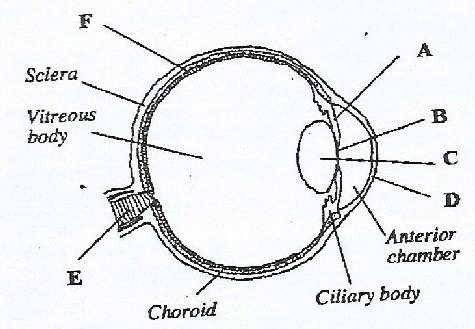
4. The diagram below shows a section of the human eye. Some parts have been labelled (sclera, vitreous body, choroid, ciliary body, anterior chamber); others are lettered A to F. a) Name the parts: A, B, C, D, E, F
- B4b3 marks
4. The diagram below shows a section of the human eye. Some parts have been labelled (sclera, vitreous body, choroid, ciliary body, anterior chamber); others are lettered A to F. b) Name three common eye defects that may limit seeing clearly.
- B5i2 marks
5. Give the meaning of the following: i. Allele
- B5ii2 marks
5. Give the meaning of the following: ii. Oviparous.
- B64 marks
6. Explain the role of DNA and RNA
- B72 marks
7. State the male and female gonads.
- B86 marks
8. Give reasons as to why biological control is better than chemical control in the control of pests and parasites.
- B93 marks
9. State Mendel's first law of inheritance.
- B103 marks
10. What is the physiological importance of why the male testis lie outside the male cavity?
- B11i1 mark
11. Give two examples of each of the following: i) Inherited traits
- B11ii1 mark
11. Give two examples of each of the following: ii) acquired traits
- B11iii1 mark
11. Give two examples of each of the following: iii) continuous variation
- B11iv1 mark
11. Give two examples of each of the following: iv) discontinuous variation
- B124 marks
12. Draw the structure of the chromosomes and label its major parts.
- B134 marks
13. Identify the cause and symptoms of typhoid disease.
- B144 marks
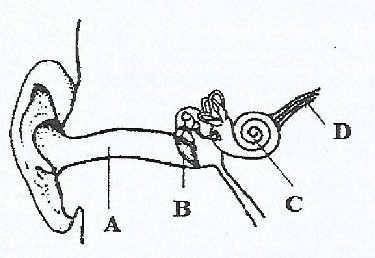
14. Below is a section of the human ear. Identify the names of A, B, C & D using the words: ear drum, auditory nerve, ear canal, cochlea.
Paper set by the Federal Ministry of Education, Culture and Higher Education (MoECHE), Somalia. Shared free of charge to help students prepare. The answers and explanations are written by Sheerxirfad teachers.