Form 4 Biology national exam 2020 with answers
The 2020 Form 4 national exam paper for Form 4 Biology, question by question. Take it timed like the real exam, then see the answer and explanation to every question.
- 42 questions, 100 marks
- 120 minutes
Take this paper
120 minutes, 100 marks. Multiple choice is marked for you; you mark your written answers against the marking points.
A free account is needed to start, so your answers and results are saved.
Instructions to candidates
Write all answers on the answer booklet. Write legibly in dark blue pen only. Answer all questions as provided in the question paper.
PART A: (10 MARKS)
Choose the correct answer and write it in the answer booklet.
- A11 mark
Which of the following neurons transmit nerve impulses from the central nervous system to the effector organ?
- A.Sensory
- B.Motor
- C.Relay
- D.Cranial
- A21 mark
Which of the following glands is classified for secreting hormone thyroxin?
- A.Adrenal gland
- B.Pituitary gland
- C.Thyroid gland
- D.Pancreas
- A31 mark
Choose the female organ that produce the ovum.
- A.Oviduct
- B.Ovary
- C.Uterus
- D.Fallopian tube
- A41 mark
The part of the flower where the pollen grain is produced is called
- A.Stigma
- B.Petal
- C.Anther
- D.Filament
- A51 mark
Select the part of the brain which controls the homeostatic functions
- A.Cerebrum
- B.Thalamus
- C.Hypothalamus
- D.Pituitary gland
- A61 mark
Which of the following statements best describes the structure of the human sperm?
- A.Ovoid head, short neck and nucleus
- B.Middle piece, short neck and mitochondria
- C.Short neck, nucleus and mitochondria
- D.Ovoid head, short neck, middle piece and tail
- A71 mark
Which of the following traits is identified as an example of continuous variation?
- A.Sex
- B.ABO blood group
- C.Tongue rolling
- D.Height
- A81 mark
When a homozygous man from blood group A marries a woman who is homozygous from blood group B, the probability of them producing an offspring of AB blood group is
- A.25%
- B.50%
- C.75%
- D.100%
- A91 mark
The type of chromosomal mutation that occurs when a section of the chromatid break and fail to reconnect to any other chromatid is called...
- A.Duplication
- B.Deletion
- C.Inversion
- D.Translocation
- A101 mark
Which of the following glands secretes the Follicle Stimulating Hormone (FSH)
- A.Corpus luteum
- B.Adrenal gland
- C.Pituitary gland
- D.Thyroid gland
PART B: (10 Marks)
Choose the correct answer for each of the blanks below and write it in the answer booklet
- B14 marks
Name two types of reproduction _____ and _____
- B22 marks
Describe the condition in which the embryo gets attached to the wall of the oviduct.
- B32 marks
The bacteria that causes syphilis is known as _____
- B42 marks
The gene that determines whether a child becomes a male or female is located on a specific pair of chromosome called _____
Section C: (80 Marks)
Answer the following Questions in the answer booklet.
- 1a1 mark
Define the term "Genetics"
- 1b2 marks
State the two types of mutation
- 25 marks
Describe the functions of the different parts of female reproductive system.
- 34 marks
Explain how impulses are passed from receptors to effectors via the central nervous system by drawing a well-labelled diagram
- 42 marks
Nocturnal animals such as the owl are capable of seeing fairly well at night. Analyze the retinal adaptations of the owl help it move at night.
- 52 marks
Using diagram illustration, analyze the genetic cross between a man with blood group A and a woman with blood group B producing offspring of all the four blood groups.
- 62 marks
Describe the differences between Phenotype and Genotype.
- 73 marks
Discuss the effects of overproduction of thyroxine on humans.
- 82 marks
Differentiate between internal fertilization and external fertilization
- 92 marks
Using the diagram below, briefly explain how the segregation of the chromatids occurs.
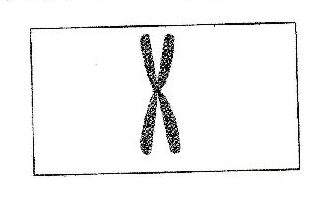
- 104 marks
Define the following terms: i. Gestation period ii. Abortion iii. Ovulation iv. Menopause
- 113 marks
Explain the physiological importance of the testes being outside the body
- 124 marks
Predict the F1 generation produced from a cross between a purebred long winged with vestigial winged flies. Let stand "W" for long winged and "w" for vestigial winged flies.
- 133 marks
Sketch and label the male parts of a flower.
- 144 marks
Mrs. Fatima claims that her child was wrongly identified at a hospital, thus taking the wrong baby. Both Fatima and her husband are blood group A while the baby's blood group is O. Evaluate whether Fatima is justified in her claim by making a genetic cross using a punnet square.
- 152 marks
Describe any two sex linked diseases.
- 165 marks
Describe the reflex action that will lead to the withdrawal of a hand after touching a hot object.
- 171 mark
Estimate the number of teeth in adult human being.
- 185 marks
Classify the following animals into carnivores, herbivores and omnivores: i. Elephant ii. Human being iii. Cat iv. Rat v. Goat
- 191 mark
Name the parasite that causes malaria to humans
- 202 marks
Discuss any two characteristics of living organisms
- 212 marks
If the base sequence of a DNA strand is A C G, T C A, G T A. Synthesize the complimentary strand of this DNA.
- 223 marks
A person is complaining of short sightedness. Explain the best possible correction method that can be used for this problem.
- 231 mark
Explain why is it difficult to cure the third stage of syphilis?
- 243 marks
Discuss the significance of meiosis.
- 254 marks
Describe the role of placenta during pregnancy to foetus
- 263 marks
If a girl started ovulation at the age of 14 and continued until the age of 49, calculate the number of eggs she produced during this.
- 275 marks
Draw and label the main parts of a well-designed diagram for the female reproductive system.
Paper set by the Federal Ministry of Education, Culture and Higher Education (MoECHE), Somalia. Shared free of charge to help students prepare. The answers and explanations are written by Sheerxirfad teachers.