Form 4 Chemistry national exam 2024 with answers
The 2024 Form 4 national exam paper for Form 4 Chemistry, question by question. Take it timed like the real exam, then see the answer and explanation to every question.
- 70 questions, 100 marks
- 120 minutes
Take this paper
120 minutes, 100 marks. Multiple choice is marked for you; you mark your written answers against the marking points.
A free account is needed to start, so your answers and results are saved.
Instructions to candidates
Answer all questions in the ANSWER BOOKLET.
SECTION A: MULTIPLE CHOICE: CIRCLE THE LETTER OF THE CORRECT ANSWER [20 MARKS]
- 11 mark
All group IA elements are found in block:
- A.S- block
- B.P- block
- C.D- block
- D.F- block
- 21 mark
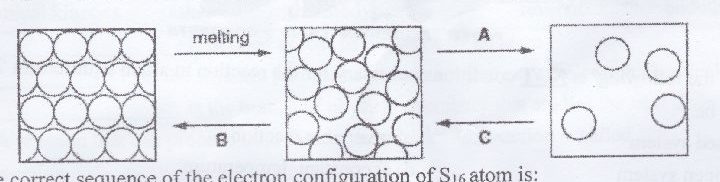
The figure below states a change of state of matter. What change state of matter occur at B? (Figure: solid --melting--> liquid --A--> gas; gas --C--> liquid; liquid --B--> solid.)
- 31 mark
The correct sequence of the electron configuration of S16 atom is:
- A.1S^2 2S^2 2P^6 3S^2 3P^6
- B.1S^2 2S^2 2P^6 3S^2 3P^4
- C.1S^2 2S^2 2P^6 3S^2 3P^3
- D.1S^2 2S^2 2P^6 3S^2 3P^5
- 41 mark
Which of the following is the main component of natural gas?
- A.Methane
- B.Ethane
- C.Propane
- D.Butane
- 51 mark
The isotope of 26/12 Mg, the number of protons and neutrons in the nucleus of magnesium atom respectively is:
- A.14 and 12
- B.16 and 12
- C.12 and 26
- D.12 and 14
- 61 mark
By applying the formula 2^(n-4)+3, how many possible isomers of nonane (C9H20) can have?
- A.32
- B.35
- C.34
- D.33
- 71 mark
The decomposition of N2O5 is described by the following reaction 2 N2O5(g) → 4NO2(g) + O2(g). If O2 is being formed at rate of 4.8mol/min, what is the rate at which N2O5 is used up?
- A.2.4mol/min
- B.4.8 mol/min
- C.9.8 mol/min
- D.9.6 mol/min
- 81 mark
The IUPAC name for the structure below is: CH3-CH(CH3)-CH(Cl)-CH2-CH(OH)-CH2-CH3 (a CH3 branch on carbon 2, Cl on carbon 3, OH on the fifth carbon, the last CH2 carrying a CH3).

- A.5-chloro-1,6-dimethyl-3-heptanol
- B.1,6-dimethyl-5-chloro-3-hexanol
- C.3-chloro-2-methyl-5-heptanol
- D.5-chloro-6-methyl-3-heptanol
- 91 mark
If R= k[A]^2[B], the overall order reaction is:
- A.1
- B.2
- C.3
- D.4
- 101 mark
Which of the following changes indicates reduction reaction?
- A.Cu becomes Cu^+2
- B.Sn^+2 becomes Sn^+4
- C.Ag becomes Ag^+
- D.Fe^+3 becomes fe^+2
- 111 mark
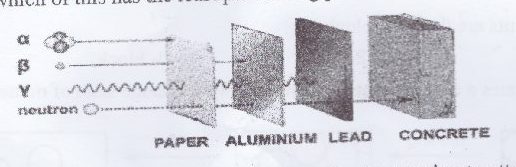
In the figure below, which of this has the least penetrating power?
- A.Alpha
- B.Beta
- C.Gamma
- D.Neutron
- 121 mark
Which one of the following is NOT conditions necessary for the reaction to attain equilibrium? The reaction must be:
- A.in closed system
- B.reversible reaction
- C.in an open system
- D.at constant temperature
- 131 mark
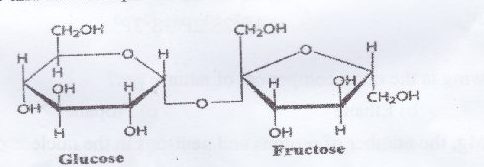
in the reaction of Glucose and fructose produces:
- A.Lactose
- B.Sucrose
- C.Cellulose
- D.Amylose
- 141 mark
Ethanol is a member of homologous series of
- A.Alkane
- B.Alkyne
- C.Aromatics
- D.Alcohol
- 151 mark
A solution with PH of 8.5 is
- A.Basic
- B.Acidic
- C.Neutral
- D.Salt
- 161 mark
The functional group of Aldehyde is
- A.-CO-
- B.-OH
- C.-COOH
- D.-CHO
- 171 mark
Which of the following p-block elements is also called chalcogen
- A.Boron family
- B.Oxygen family
- C.Nitrogen family
- D.Carbon family
- 181 mark
The reaction between alcohol and carboxylic acid in the presence of acid catalyst forms:
- A.Ester
- B.Ether
- C.Amide
- D.Aldehyde
- 191 mark
The relative atomic mass(RAM) of Na2SO4 [Na=23, S=32 O=16] is
- A.114g/mol
- B.124g/mol
- C.142g/mol
- D.144g/mol
- 201 mark
For the reaction: 2SO2(g) + O2(g) → 2SO3(g); Which direction will the equilibrium shift, if the pressure of the system is decreased?
- A.No affect
- B.Same constant
- C.Right
- D.Left
SECTION B: FILL IN THE BLANK SPACES (10 MARKS)
Use the words in the box to fill in the blank spaces: oxidation, mechanism, covalent, aqueous solution, atom, chemical kinetics, ether, thermodynamics, reversible, endothermic
- B11 mark
Use the words in the box: oxidation, mechanism, covalent, aqueous solution, atom, chemical kinetics, ether, thermodynamics, reversible, endothermic. _____ is defined as loss of electrons by an atom
- B21 mark
Use the words in the box: oxidation, mechanism, covalent, aqueous solution, atom, chemical kinetics, ether, thermodynamics, reversible, endothermic. _____ is the smallest particle of an element that can take part in chemical reaction.
- B31 mark
Use the words in the box: oxidation, mechanism, covalent, aqueous solution, atom, chemical kinetics, ether, thermodynamics, reversible, endothermic. _____ is the branch of physical chemistry that studies the heat flow.
- B41 mark
Use the words in the box: oxidation, mechanism, covalent, aqueous solution, atom, chemical kinetics, ether, thermodynamics, reversible, endothermic. A reaction that can proceed both forward and backward reaction is called_____ reaction
- B51 mark
Use the words in the box: oxidation, mechanism, covalent, aqueous solution, atom, chemical kinetics, ether, thermodynamics, reversible, endothermic. If we use water as a solvent, then the solution is called_____
- B61 mark
Use the words in the box: oxidation, mechanism, covalent, aqueous solution, atom, chemical kinetics, ether, thermodynamics, reversible, endothermic. CH3-CH2-O-CH2-CH3 is an example of _____
- B71 mark
Use the words in the box: oxidation, mechanism, covalent, aqueous solution, atom, chemical kinetics, ether, thermodynamics, reversible, endothermic. The reaction that absorbs energy is called _____ reaction
- B81 mark
Use the words in the box: oxidation, mechanism, covalent, aqueous solution, atom, chemical kinetics, ether, thermodynamics, reversible, endothermic. _____ is a branch of chemistry that deals with rate of reaction, factors affecting these rates and mechanism of reaction
- B91 mark
Use the words in the box: oxidation, mechanism, covalent, aqueous solution, atom, chemical kinetics, ether, thermodynamics, reversible, endothermic. The sequence of elementary steps that together make a complete chemical reaction is known as _____ of reaction.
- B101 mark
Use the words in the box: oxidation, mechanism, covalent, aqueous solution, atom, chemical kinetics, ether, thermodynamics, reversible, endothermic. There are two major types of chemical bonding: ionic bond and _____ bond.
SECTION C: MATCHING (10 MARKS)
Match the words in Column A with corresponding words in Column B using the Brackets
- C11 mark
Match the word in Column A with the corresponding words in Column B. Column A: Carbohydrates. Column B: the short chains attached to the parent chain; reaction between acids and bases to form salt; the most abundant isotope of hydrogen; the longest straight chain of carbon atom; formula of Kc; is the product of oxidation of aldehydes; reaction in which one atom is displaced by another atom; is the isomer of the formula of alkene; the most abundant organic compound in nature; formula of Kw.
- C21 mark
Match the word in Column A with the corresponding words in Column B. Column A: [Product]/[Reactant]. Column B: the short chains attached to the parent chain; reaction between acids and bases to form salt; the most abundant isotope of hydrogen; the longest straight chain of carbon atom; formula of Kc; is the product of oxidation of aldehydes; reaction in which one atom is displaced by another atom; is the isomer of the formula of alkene; the most abundant organic compound in nature; formula of Kw.
- C31 mark
Match the word in Column A with the corresponding words in Column B. Column A: Neutralization. Column B: the short chains attached to the parent chain; reaction between acids and bases to form salt; the most abundant isotope of hydrogen; the longest straight chain of carbon atom; formula of Kc; is the product of oxidation of aldehydes; reaction in which one atom is displaced by another atom; is the isomer of the formula of alkene; the most abundant organic compound in nature; formula of Kw.
- C41 mark
Match the word in Column A with the corresponding words in Column B. Column A: Substitution. Column B: the short chains attached to the parent chain; reaction between acids and bases to form salt; the most abundant isotope of hydrogen; the longest straight chain of carbon atom; formula of Kc; is the product of oxidation of aldehydes; reaction in which one atom is displaced by another atom; is the isomer of the formula of alkene; the most abundant organic compound in nature; formula of Kw.
- C51 mark
Match the word in Column A with the corresponding words in Column B. Column A: Parent chain. Column B: the short chains attached to the parent chain; reaction between acids and bases to form salt; the most abundant isotope of hydrogen; the longest straight chain of carbon atom; formula of Kc; is the product of oxidation of aldehydes; reaction in which one atom is displaced by another atom; is the isomer of the formula of alkene; the most abundant organic compound in nature; formula of Kw.
- C61 mark
Match the word in Column A with the corresponding words in Column B. Column A: Cycloalkane. Column B: the short chains attached to the parent chain; reaction between acids and bases to form salt; the most abundant isotope of hydrogen; the longest straight chain of carbon atom; formula of Kc; is the product of oxidation of aldehydes; reaction in which one atom is displaced by another atom; is the isomer of the formula of alkene; the most abundant organic compound in nature; formula of Kw.
- C71 mark
Match the word in Column A with the corresponding words in Column B. Column A: Side chain. Column B: the short chains attached to the parent chain; reaction between acids and bases to form salt; the most abundant isotope of hydrogen; the longest straight chain of carbon atom; formula of Kc; is the product of oxidation of aldehydes; reaction in which one atom is displaced by another atom; is the isomer of the formula of alkene; the most abundant organic compound in nature; formula of Kw.
- C81 mark
Match the word in Column A with the corresponding words in Column B. Column A: [H3O][OH-]. Column B: the short chains attached to the parent chain; reaction between acids and bases to form salt; the most abundant isotope of hydrogen; the longest straight chain of carbon atom; formula of Kc; is the product of oxidation of aldehydes; reaction in which one atom is displaced by another atom; is the isomer of the formula of alkene; the most abundant organic compound in nature; formula of Kw.
- C91 mark
Match the word in Column A with the corresponding words in Column B. Column A: Carboxylic acid. Column B: the short chains attached to the parent chain; reaction between acids and bases to form salt; the most abundant isotope of hydrogen; the longest straight chain of carbon atom; formula of Kc; is the product of oxidation of aldehydes; reaction in which one atom is displaced by another atom; is the isomer of the formula of alkene; the most abundant organic compound in nature; formula of Kw.
- C101 mark
Match the word in Column A with the corresponding words in Column B. Column A: Protium. Column B: the short chains attached to the parent chain; reaction between acids and bases to form salt; the most abundant isotope of hydrogen; the longest straight chain of carbon atom; formula of Kc; is the product of oxidation of aldehydes; reaction in which one atom is displaced by another atom; is the isomer of the formula of alkene; the most abundant organic compound in nature; formula of Kw.
SECTION D: STRUCTURED QUESTIONS (60 MARKS)
- D1a2 marks
Define the following term: Alkene (2 marks)
- D1b2 marks
Define the following term: Ether (2 marks)
- D1c2 marks
Define the following term: Nuclear chemistry (2 marks)
- D2a2 marks
If the concentration of HNO3 in a solution is 0.025M, Calculate: pH (2 marks)
- D2b2 marks
If the concentration of HNO3 in a solution is 0.025M: Name HNO3 (2 marks)
- D2c1 mark
If the concentration of HNO3 in a solution is 0.025M: Determine its conjugate bases (1 marks)
- D3a2 marks
Differentiate between Primary alcohol and secondary alcohol (2 marks)
- D3b2 marks
Differentiate between Nuclear fusion and nuclear fission (2 marks)
- D3c2 marks
Differentiate between Ketone and aldehyde (2 marks)
- D4a2 marks
Draw the structural formula of: 2,4,5-trimethyloctane (2 marks)
- D4b2 marks
Draw the structural formula of: 4-chloro-2-pentanol (2 marks)
- D4c2 marks
Draw the structural formula of: 2-methoxypropane (2 marks)
- D5a2 marks
Cesium-137, used in cancer treatment, has a half-life of 30 yrs. Write the balanced nuclear equation for the beta decay of Cs-137 (137/55 Cs). (2 marks)
- D5b3 marks
Cesium-137, used in cancer treatment, has a half-life of 30 yrs. How many milligrams of a 16 mg sample of cesium-137 remain after 90 yrs. (3 marks)
- D64 marks
Classify the following in to exothermic and endothermic reactions (4 marks): Photosynthesis, Combustion, Respiration, Cracking of alkanes
- D7a2 marks
Bromine has an atomic number of (Z=35) has a nuclear symbol of 80/35 Br. Write the electron configuration of Br35, using sub-shell notation (2 marks)
- D7b2 marks
Bromine has an atomic number of (Z=35) has a nuclear symbol of 80/35 Br. state the block which bromine belongs to? (2 marks)
- D7c2 marks
Bromine has an atomic number of (Z=35) has a nuclear symbol of 80/35 Br. Write the valence electron of bromine? (2 marks)
- D8a2 marks
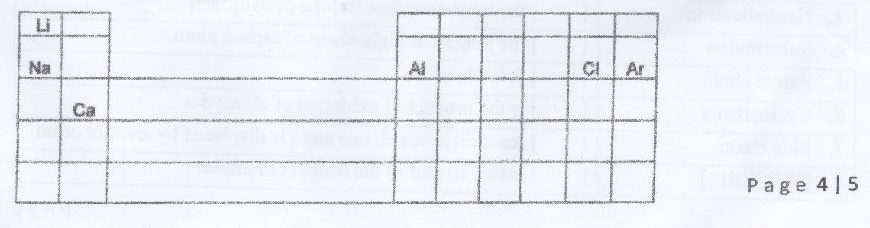
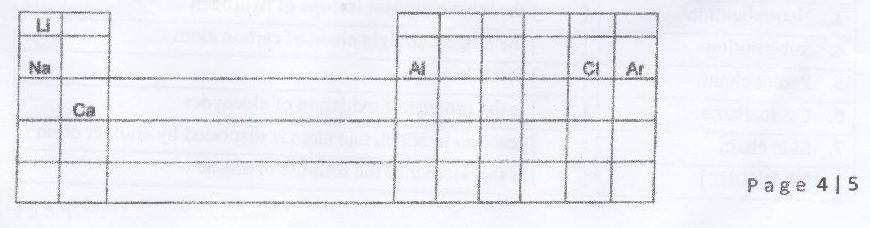
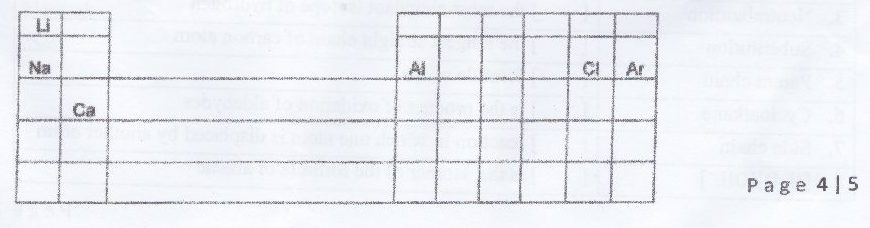
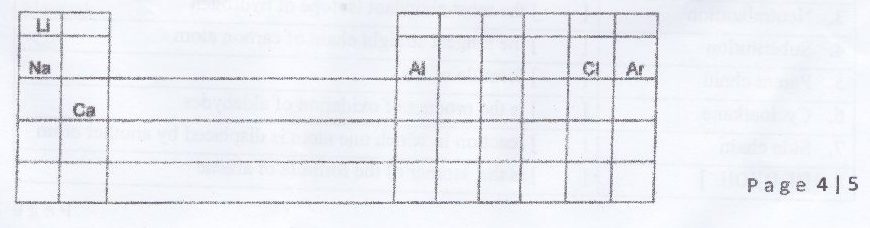
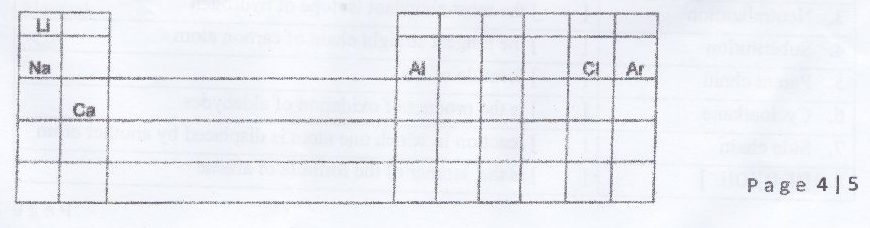
Below is a Grid representing a part of periodic table (it shows Li and Na in the first column, Ca in the second column, Al, Cl and Ar on the right). Which two elements are in the same group? (2marks)
- D8b1 mark
Below is a Grid representing a part of periodic table (it shows Li and Na in the first column, Ca in the second column, Al, Cl and Ar on the right). Which element belongs to boron family? (1mark)
- D8c3 marks
Below is a Grid representing a part of periodic table (it shows Li and Na in the first column, Ca in the second column, Al, Cl and Ar on the right). Which elements belongs to p-block elements (3 marks)
- D8d1 mark
Below is a Grid representing a part of periodic table (it shows Li and Na in the first column, Ca in the second column, Al, Cl and Ar on the right). What name is given to the elements in group eight or Zero? (1 marks)
- D8e2 marks
Below is a Grid representing a part of periodic table (it shows Li and Na in the first column, Ca in the second column, Al, Cl and Ar on the right). Write the full names for the symbols: i) Na ii. Ar (2marks)
- D9a2 marks
Answer the following questions related to the chemical equilibrium concept: What are types of chemical equilibrium? (2 Marks)
- D9b4 marks
Calculate the Kc from the following equilibrium concentrations for the reaction 3H2(g) + N2(g) → 2NH3(g): [H2] = 0.0163 M, [NH3] = 0.0165 M, [N2] = 0.65 M (4 Marks)
- D9c1 mark
For the reaction 3H2(g) + N2(g) → 2NH3(g) with Kc of about 97: Does this reaction is product favored or reactant favored? (1marks)
- D10a3 marks
238/92 U → 4/2 He + A/Z X + 2 0/0 γ. What are types of radioactive decays? (3 marks)
- D10b1 mark
238/92 U → 4/2 He + A/Z X + 2 0/0 γ. Which kind of radioactive decays occurs in the equation above? (1 marks)
- D10c1 mark
238/92 U → 4/2 He + A/Z X + 2 0/0 γ. Identify the value of A (1 marks)
- D10d1 mark
238/92 U → 4/2 He + A/Z X + 2 0/0 γ. Identify the value of Z (1 marks)
Paper set by the Federal Ministry of Education, Culture and Higher Education (MoECHE), Somalia. Shared free of charge to help students prepare. The answers and explanations are written by Sheerxirfad teachers.