Form 4 Chemistry national exam 2021 with answers
The 2021 Form 4 national exam paper for Form 4 Chemistry, question by question. Take it timed like the real exam, then see the answer and explanation to every question.
- 45 questions, 100 marks
- 120 minutes
Take this paper
120 minutes, 100 marks. Multiple choice is marked for you; you mark your written answers against the marking points.
A free account is needed to start, so your answers and results are saved.
Instructions to candidates
Answer all questions in the ANSWER BOOKLET. Time: 2 hours.
Section A (40 Marks, 2 marks each)
Choose the correct answer from the alternatives given in each question
- 12 marks
Hydrocarbons are compounds that contain _____
- A.Carbon only
- B.Hydrogen only
- C.Oxygen
- D.Carbon and hydrogen
- 22 marks
The simplest number of alkenes is known as _____
- A.Butane
- B.Ethane
- C.Ethene
- D.Propene
- 32 marks
Which of the following groups has the most reactive non-metals _____
- A.Alkali metals
- B.alkaline metals
- C.halogens
- D.noble gas
- 42 marks
The general formula of alkanes is _____
- A.CnH2n+2
- B.CnH2n
- C.CnH2n+1
- D.CnH2n-1
- 52 marks
Phosphorous-32 has a half-life of 14.3 days. If a sample contains 8.0 mg of phosphoros-32 how many milligrams of phosphorous-32 remains after 42.9 days?
- A.4 mg
- B.6 mg
- C.2.5 mg
- D.1 mg
- 62 marks
_____ is the simplest form of cyclo alkanes
- A.Cyclo butane
- B.cyclo pentane
- C.cyclo propane
- D.cyclo hexane
- 72 marks
According to the general formula of alkenes (CnH2n), the molecular formula of butane is
- A.C4H10
- B.C4H8
- C.C4H12
- D.C4H6
- 82 marks
The hydrophilic part of alcohol is called _____
- A.Alkyl part
- B.hydroxyl part
- C.hydrogen part
- D.carbon part
- 92 marks
The structural formula of ketones is _____
- A.R-O-R
- B.R-C(=O)-R
- C.R-C(=O)-H
- D.R-C(=O)-O-R
- 102 marks
If the number of protons and neutrons in a nucleus are 11, 12 respectively, the nuclear symbol would be:
- A.12/11 X (mass 12, atomic number 11)
- B.11/12 X (mass 11, atomic number 12)
- C.23/11 X (mass 23, atomic number 11)
- D.23/12 X (mass 23, atomic number 12)
- 112 marks
The balance nuclear equation for (11/6 C) that produces a protons is _____
- A.11/6 C -> 1/1 e + 12/7 N
- B.11/6 C -> 0/1 e + 11/5 B
- C.11/6 C -> 0/1 e + 12/7 B
- D.11/6 C -> 0/1 e + 11/7 B
- 122 marks
_____ is the substance that speed up the rate of reaction.
- A.Reactants
- B.Products
- C.Catalyst
- D.Activation energy
- 132 marks
Identify the structure of 2-methyl pentane from the below structures.
- A.CH3-CH2-CH2-CH(CH3)-CH3
- B.CH3-CH(CH3)-CH3
- C.CH3-CH2-CH2-CH2-CH3
- D.CH3-C(CH3)2-CH3
- 142 marks
Which of the following structures is saturated:
- A.CH=CH3
- B.CH=CH-CH3
- C.CH3-CH3
- D.CH3-CH2-C=CH
- 152 marks
Which of the following figures indicates 2-methylphenol;
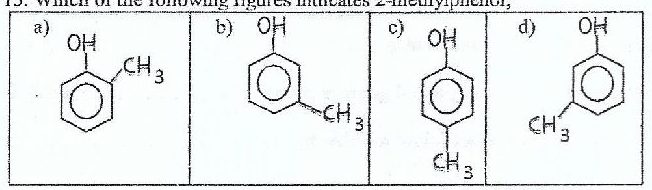
- A.Figure a (CH3 next to OH)
- B.Figure b
- C.Figure c (CH3 opposite OH)
- D.Figure d
- 162 marks
The functional group that contains both aldehyde and ketone is known as _____
- A.Aldehyde group
- B.ketone group
- C.carbonyl group
- D.amino group
- 172 marks
When one large nucleus splits into two smaller nucleus, this nuclear reaction is known as
- A.Fusion reaction
- B.fission reaction
- C.ionizing radiation
- D.alpha decay
- 182 marks
Example of monosaccharide that contains five carbon (pentose) is _____
- A.Erythrose
- B.ribose
- C.galactose
- D.cellulose
- 192 marks
Which of the following is homogeneous chemical equilibrium
- A.CO2(g) + C(s) <=> 2CO(g)
- B.CaCO3(s) <=> CaO + CO2
- C.P4(s) + 6Cl2(g) <=> 4PCl3
- D.N2 + O2 <=> 2NO(g)
- 202 marks
Le Chatelier's principle states that if one or more factors disturb equilibrium, the position of equilibrium will shift in order to _____ the change.
- A.Oxidize
- B.increase
- C.induce
- D.reduce
Section B (10 Marks, 1 mark each)
Fill in the empty blank with suitable word from the box below
- B11 mark
Fill in the empty blank with suitable word from the box (Isomers, Biomolecules, CnH2n-2, Dihydroxy, Peptide, R-COOH, Fatty, Chemical, Product, Alpha): The general structure of organic acid is _____
- B21 mark
Fill in the empty blank with suitable word from the box (Isomers, Biomolecules, CnH2n-2, Dihydroxy, Peptide, R-COOH, Fatty, Chemical, Product, Alpha): The alcohol that contain two hydroxyl group is called _____ alcohol.
- B31 mark
Fill in the empty blank with suitable word from the box (Isomers, Biomolecules, CnH2n-2, Dihydroxy, Peptide, R-COOH, Fatty, Chemical, Product, Alpha): Amino acids in the proteins are joined together by _____ bond
- B41 mark
Fill in the empty blank with suitable word from the box (Isomers, Biomolecules, CnH2n-2, Dihydroxy, Peptide, R-COOH, Fatty, Chemical, Product, Alpha): The general formula of alkyne is _____
- B51 mark
Fill in the empty blank with suitable word from the box (Isomers, Biomolecules, CnH2n-2, Dihydroxy, Peptide, R-COOH, Fatty, Chemical, Product, Alpha): The building unit of triglycerides is glycerol and _____ acids
- B61 mark
Fill in the empty blank with suitable word from the box (Isomers, Biomolecules, CnH2n-2, Dihydroxy, Peptide, R-COOH, Fatty, Chemical, Product, Alpha): _____ equilibrium is a state in which the rates of the forward and reverse reactions are equal.
- B71 mark
Fill in the empty blank with suitable word from the box (Isomers, Biomolecules, CnH2n-2, Dihydroxy, Peptide, R-COOH, Fatty, Chemical, Product, Alpha): The chemical constituents of the living system are called _____
- B81 mark
Fill in the empty blank with suitable word from the box (Isomers, Biomolecules, CnH2n-2, Dihydroxy, Peptide, R-COOH, Fatty, Chemical, Product, Alpha): The radioactive decay which carry positive charge is known as _____ particles
- B91 mark
Fill in the empty blank with suitable word from the box (Isomers, Biomolecules, CnH2n-2, Dihydroxy, Peptide, R-COOH, Fatty, Chemical, Product, Alpha): In equilibrium constant expression, if the value of Kc is greater than one (Kc > 1), this reaction is said to be _____ favoured.
- B101 mark
Fill in the empty blank with suitable word from the box (Isomers, Biomolecules, CnH2n-2, Dihydroxy, Peptide, R-COOH, Fatty, Chemical, Product, Alpha): _____ are molecules with the same molecular formula but different structural formula.
Section C (50 marks): Answer all questions in the section
- C1a2 marks
a) What does IUPAC stands for? (2 mark)
- C1b-a1 mark
b) Give IUPAC names to the following organic molecules (4 marks): a) CH3-CH(CH3)-CH2-CH3
- C1b-b1 mark
b) Give IUPAC names to the following organic molecules (4 marks): b) CH3-CH=CH-CH(Br)-CH(CH3)-CH3
- C1b-c1 mark
b) Give IUPAC names to the following organic molecules (4 marks): c) CH3-CH(Cl)-CH2-OH
- C1b-d1 mark
b) Give IUPAC names to the following organic molecules (4 marks): d) CH3-CH2-C(=O)-H
- C23 marks
Phenols are hydroxyl derivatives of benzene that have aromas smell, state three uses of phenols. (3 Marks)
- C33 marks
Draw the possible structural formula for isomers of pentane using the following formula (2^(n-4) + 1). (3 marks)
- C4a2 marks
Define: a. The term biochemistry? (2 mark)
- C4b5 marks
b. Briefly explain the major types of biochemistry. (5 marks)
- C56 marks
Calculate the equilibrium constant (Kc), if the equilibrium concentrations are as follows: PCl5 (g) <=> PCl3 (g) + Cl2 (g). [PCl5] = 0.0096M, [PCl3] = 0.0247M, and [Cl2] = 0.0247M. (6 marks)
- C65 marks
The half-life of polonium-210 is 138.4 days, how many milligrams (mg) of polonium-210 remain after 415.2 day if you start with 2.0 mg of polonium-210? (5 marks)
- C75 marks
The rate of chemical reaction increases with increase in the presence of catalyst, explain. (5 marks)
- C85 marks
Distinguish between ionizing and non-ionizing radiation. (5 marks)
- C95 marks
A radioactive isotope of 38/19 K, emits a radioactive emission and changes into 36/18 Ar. Synthesize the balanced equation of this nuclear reaction (5 marks)
- C105 marks
Show the electron configuration of fluorine (9F) and chlorine (17Cl) (5 marks)
Paper set by the Federal Ministry of Education, Culture and Higher Education (MoECHE), Somalia. Shared free of charge to help students prepare. The answers and explanations are written by Sheerxirfad teachers.